New journal homepage design
User-centric redesign for enhanced usability on Taylor & Francis Online
We’ve recently launched a brand-new homepage design for all journals on Taylor & Francis Online. They now offer:
- A new user-centric journal landing page, reorganized for enhanced usability.
- An intuitive new navigation menu helping users to discover and explore all aspects of a journal more easily, regardless of the page they started on.
- Improved signposting for authors allowing them to quickly find the key information they need to make a submission decision.
- A redesigned and optimized user experience for mobile devices, providing a simplified and familiar mobile browsing experience.
Please note that your journal also now has a new URL (website address).
Explore some of the most important features below, along with some frequently asked questions.
Overview
Here’s a screenshot of the new journal homepage as it looks for desktop users. Please click on the image to view in higher resolution.

Key features of the new design
Horizontal navigation menu
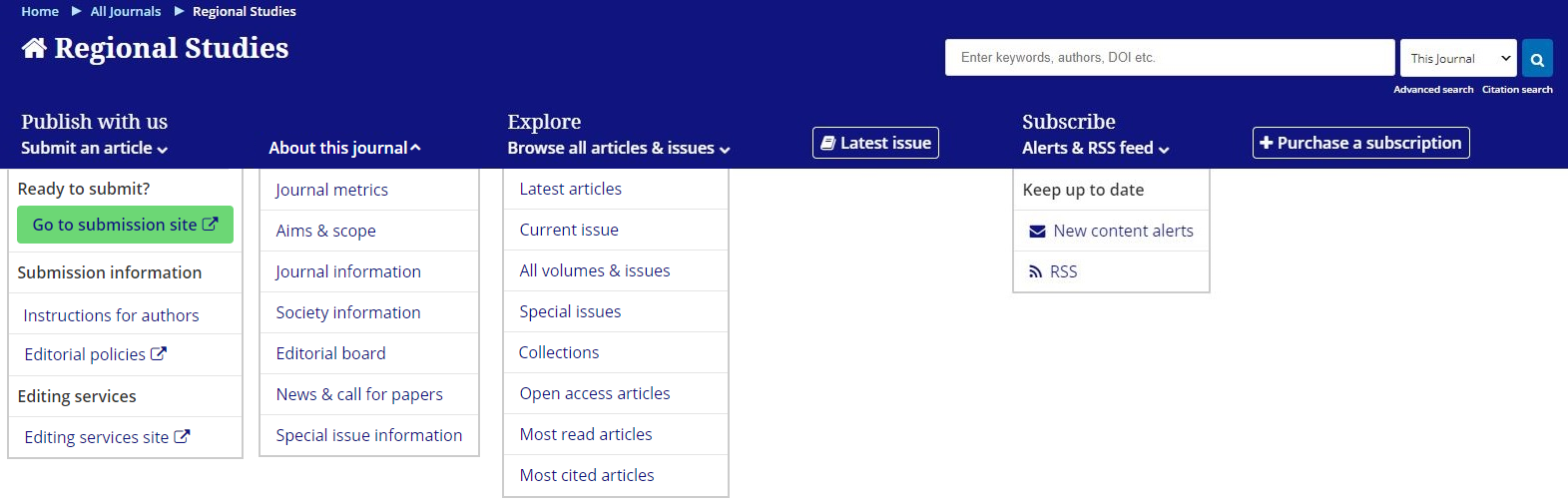
The new horizontal navigation menu is designed to make it as easy as possible for users to discover and reach all pages, published content, and actions associated with a journal. As the user scrolls down the homepage, the navigation sticks to the top of the page and remains visible on screen.
The new intuitive navigation menu is also applied to all other pages within a journal, meaning the user always has these key navigation options at their fingertips, regardless of which page they are visiting or how far down a page they have scrolled.
The image below shows the different menu options. Please click on the image to view in higher resolution.
‘Journal overview’
Usage data shows that the four most popular pages for authors are the Aims and scope, Journal metrics, Editorial board, and Instructions for authors pages. The new ‘Journal overview’ section aims to make it as easy as possible for users to locate this important information.
‘Latest articles’
The ‘Latest articles’ section showcases the journal’s most recent and open access articles, alongside links to view the most downloaded and most cited articles.
‘Latest issues’
The ‘Latest issues’ section features the journal’s two most recent issues, alongside links to the full list of issues, a list of special issues, and any collections.
‘Associated journals’
This optional section is designed for societies and organizations who publish multiple journals hosted on Taylor & Francis Online, or for multi-part journals that have a direct relationship with each other. It allows users to easily discover related publications, encouraging further exploration.
‘Updates’
The ‘Updates’ section is designed to promote journal news, offers, and call for papers links. This highly visible section appears at the top of the right-hand column on desktop sizes, or within the main page body on mobile and tablet sizes.
New mobile homepage
Approximately 25% of Taylor & Francis Online visitors use a mobile device (a number that’s growing year-on-year). The new journal homepages have therefore been built using a ‘mobile first’ design philosophy. This has helped ensure that the new layout works on all devices: from the smallest mobile and tablet screens through to larger laptop and desktop sizes.
Each of the new homepage elements that appear on desktop sizes are reflowed and repositioned on mobile, making them easier to understand, navigate, scroll and tap. A simplified and focused version of the new horizontal navigation menu also features on the mobile layout and is presented in common global style that will be familiar to the user.
Here’s a screenshot of the new journal homepage as mobile users see it, through various stages of scrolling. Please click on the image to view in higher resolution.

Frequently asked questions
What data was used to inform and influence the new journal homepage design and associated changes?
The new design is born from extensive analysis of existing user behavior data, collected from Taylor & Francis Online using tools like Google Analytics and Hotjar. We looked at how users were interacting with existing journal level pages to identify current pain-points and areas where the user-flow could be optimized, whilst also identifying areas of the existing design that were successful and didn’t require any change.
We also incorporated feedback provided by end users in interviews and surveys, and have tested and validated the new design with authors and researchers to ensure it meets their needs.
What is the new homepage URL and are there any changes to existing/current URLs?
The new journal homepage URL format is: https://www.tandfonline.com/journals/abcd
Replace the four letter ‘abcd’ code with the Taylor & Francis code for your journal (e.g. for ‘Regional Studies’ this would be https://www.tandfonline.com/journals/cres).
Please use this new URL for all journal-level promotion. Please get in touch with your Taylor & Francis contact if you don’t already know the four-letter code for your journal.
The short-form journal URL format (e.g. https://www.tandfonline.com/abcd) has been reconfigured to redirect to the new journal homepage, rather than the current issue.
To preserve existing backlinks, we have not removed or changed the format of any pre-existing URLs for your journal.
Can I update, change or customize any of the information displayed on the new homepage design?
If you’d like to update the aims and scope text or post new journal news or calls for papers, please discuss this with your Portfolio Manager.
To provide a consistent experience from journal to journal, all other elements of the new design are automatically populated and cannot be customized or removed.
Can I add or remove titles from the new ‘Associated journals’ section?
We identified all journals that are applicable for the new ‘Associated journals’ section (approximately 280 titles) before release, so these relationships should already be displayed for your journal. However, if you find missing or erroneous associated journals on your homepage, please get in touch with your Portfolio Manager.
My society/organization has a society portal site managed by Taylor & Francis. Will the new journal homepage design and associated changes be applied to society portals?
Yes. The changes described above have also already been applied to society portal sites. On society portals, the color of the new horizontal navigation menu has been customized to match the colors/branding used on your portal.