Associate Editors needed for Development in Practice
Associate Editor required
Deadline 22 June 2026
About the role
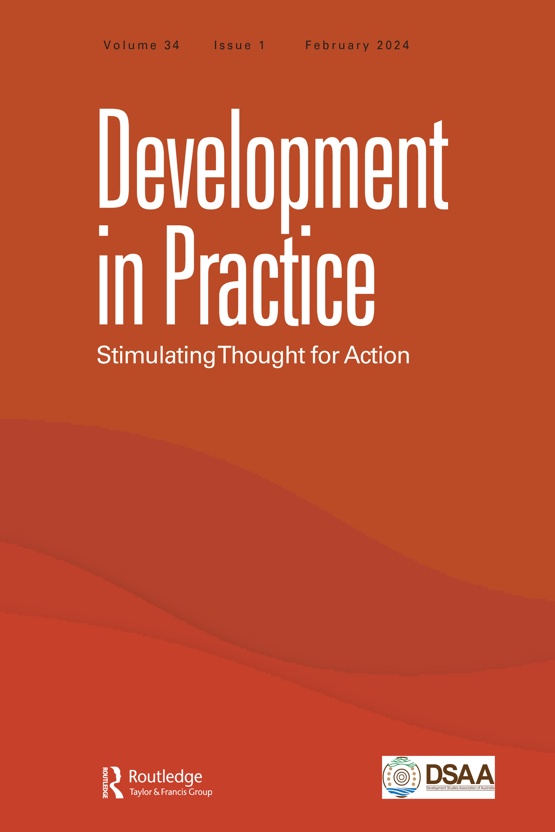
Development in Practice seeks expressions of interest for the role of Associate Editor. Associate Editors are responsible for inviting reviewers for assigned manuscripts (usually one or two per month) on an ongoing basis. From time to time, they will be asked to act as reviewers, particularly for 3,000-word viewpoints and practice notes. They may also provide advice on other strategic and ongoing issues relating to the journal as requested by the Editorial Team. They are expected to attend two strategic planning meetings per year. Training sessions will be provided as necessary on the journal’s editing management system, ScholarOne. This is a volunteer position. All Associate Editors will be listed on the DiP website along with their affiliation. Associate Editors will receive a free subscription to DiP, as set out in the DiP/DSAA contract, and their reviews will be acknowledged in the relevant volume. This role is a great opportunity for an academic or practitioner with a strong commitment to global development practice. We welcome applications from early-career and more established researchers and practitioners across the globe, and we will give particular consideration to applicants based in the Global South.About the journal
- Gender, social identities and intersectionality – this includes gender identities, race, caste, class, ethnicity, sexual orientation, age (youth and older people)
- Indigenous development issues in the Global South and North
- Environment, including resources and biodiversity; climate justice, including adaptation and resilience
- Social protection and vulnerability
- Agriculture, including subsistence agriculture and food systems
- Livelihoods, urbanisation, work
- Development in theory and practice – including development actors, participatory approaches, alternative development approaches, and sustainable development
- Development and migration – forced migration, labour migration, displacement, resettlement, remittances
- Critical approaches to household finance for development and their social impacts, including, remittances and microcredit and savings schemes
- Conflict and peacebuilding
- Communication for development.
Key Skills and Attributes
- Proficiency in English.
- Experience in global development.
- A network of local and regional practitioners/academics in the Global South.
- The capacity to devote one hour a month to the role, and to attend Associate Editor meetings (2 per year) and training sessions as needed.
- A willingness to promote the journal within their region/area of expertise and encourage submissions to the journal.
- An interest in and enthusiasm for furthering the reach of the journal.
- Previous experience working with editorial management systems, such as ScholarOne.
Application instructions
Please forward expressions of interest to the Editorial Team on [email protected] by 20 June 2026. Expressions of interest should include a cover letter outlining your suitability for the role, as well as a CV. Associate Editors are appointed by and report to the DiP Editorial Team (the Chief Editor, two Deputy Editors, and Managing Editor), with the responsibility of consulting on the editorial direction of DiP.Journal pledge
The journal is committed to ensuring diversity, equity and inclusion within its editorial team and decision making processes. All applications will be treated as strictly confidential, and each will be judged on its merits without bias for seniority of institutional affiliation. We do not discriminate on the basis of race, colour, ancestry, national origin, religion, or religious creed, mental or physical disability, medical condition, genetic information, sex (including pregnancy, childbirth, and related medical conditions), sexual orientation, gender identity, gender expression, age, marital status, military or protected veteran status, citizenship, or other protected characteristics.
Did you know
Joining a Taylor & Francis journal as an Editor or Board member brings many personal and professional benefits.
Find more roles in your subject area with our Editor Recruitment search tool.