Historical Biology
Data Editor required
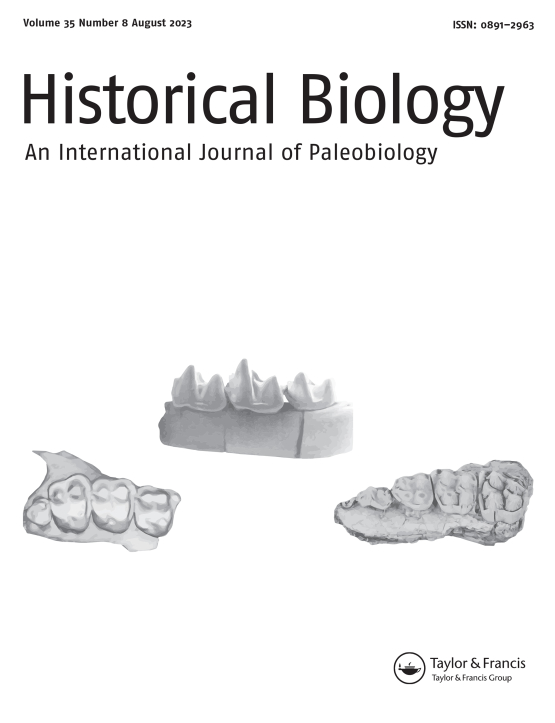
Deadline 11 August 2026
About the role
Historical Biology is seeking a Data Editor.
Historical Biology is dedicated to principles of Open and FAIR Science and is requiring that authors ensure that, at the point of submission, all data and/or code must be publicly available in an online repository that mints a DOI.
This vision is supported by our team of Data Editors. As part of this role, you will be part of a team of three Data Editors responsible for helping authors with difficulties or concerns to deposit their data in a way that complies with the journal’s data policy.
This role is a great opportunity for a researcher with a strong background in Open and FAIR data practices within paleontology and who cares passionately about reproducibility and openness in the field.
In this role, you will:
- assist authors and editors with queries relating to depositing data in an Open, and ideally FAIR, manner using suitable repositories
- help review Data Availability Statements and provide guidance to authors where needed
- uphold research integrity and publishing ethics, ensuring all handled manuscripts adhere to COPE guidelines.
- actively promote the journal within your professional networks and represent the title at key events and conferences.
- participate in regular Editorial Board meetings to discuss journal performance, pipeline metrics, and long-term strategy.
Stepping into a Data Editor role is a rewarding journey that enables you to influence the future of your field. You will gain deep insights into the publishing process, expand your global professional network, and be recognized as a leading figure in the community.
The appointment will start in August 2026 or as soon as possible thereafter.
About the journal
Historical Biology is an international peer reviewed journal publishing papers covering evolutionary and systematic biology through time. The Journal is not limited by taxonomic group, publishing papers from human origins to the palaeobiology of the gigantic shark megalodon, to the latest developments in palaeobotany. The Journal accepts manuscripts on novel, theoretical, philosophical, and/or controversial topics, but also accepts so-called ‘negative results’ – as it is as important for the international community to know what does not work as what does. The range of subjects the Journal covers includes:
- descriptive and comparative anatomy,
- taxonomy, systematics, and nomenclature,
- philosophy of biology (and topics related to deep time perspectives),
- descriptions of new datasets and methods,
- phylogenetic, comparative, and multivariate statistical analyses,
- palaeobiology (including biomechanics, histology, system biology CT reconstructions),
- palaeobiogeography,
- evolutionary patterns and processes,
- molecular palaeontology,
- taphonomy.
Key Skills and Attributes
Ready to apply? We’re seeking candidates who demonstrate:
Editorial Excellence & Leadership
- Proven experience in academic publishing and data management
- Skill in reading, synthesising, and making sound editorial decisions
- Strong awareness of data deposition practices in paleontology and subject specific repositories
- A clear vision and enthusiasm for the journal’s ongoing development towards Open and FAIR compliance
Operational Proficiency
- Ability to commit time each week to the role and to participate in Editorial Board meetings and training as needed.
- Proficiency with online peer-review management systems, with the confidence to guide and support the editorial team in their use.
- Proactive engagement with Taylor & Francis staff and suppliers to implement processes and drive improvements.
Integrity & Excellence
- Experience collaborating effectively with other editors, reviewers, and journal staff
- Uncompromising ethical standard ideally with knowledge of COPE guidelines and a commitment to always uphold them.
- Active growth of academic networks through conference participation and professional use of social media.
Application instructions
Applications should include your CV and a Cover Letter.
Your Cover Letter should be no longer than 500 words, state clearly your background and interest in Open and FAIR data practices in paleontology.
Early application is encouraged. For any questions, please contact Senior Publisher, Dr Matthew Warke ([email protected]).
Apply for the role by filling in our formJournal pledge
The journal is committed to ensuring diversity, equity and inclusion within its editorial team and decision making processes. All applications will be treated as strictly confidential, and each will be judged on its merits without bias for seniority of institutional affiliation. We do not discriminate on the basis of race, colour, ancestry, national origin, religion, or religious creed, mental or physical disability, medical condition, genetic information, sex (including pregnancy, childbirth, and related medical conditions), sexual orientation, gender identity, gender expression, age, marital status, military or protected veteran status, citizenship, or other protected characteristics.
Did you know
Joining a Taylor & Francis journal as an Editor or Board member brings many personal and professional benefits.
Find more roles in your subject area with our Editor Recruitment search tool.